Venues
ZHdK Research Tours
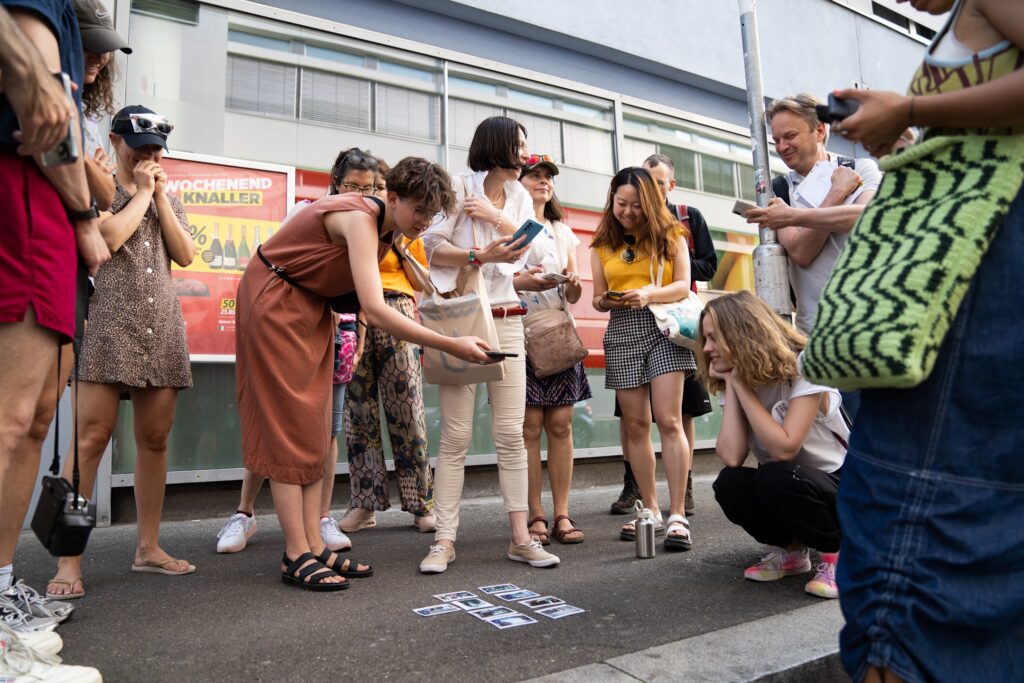
For Zurich Art Weekend 2026, an innovative research-driven tour format has been developed in collaboration with the MA Cultural Critique, Curatorial Studies (head: Prof. Dr. Anselm Franke) from Zurich University of the Arts (ZHdK) and with the support of Hannah Eßler. These tours will lead audiences to unique and behind-the-scenes locations across Zurich, guided by emerging curators Anja Roosens, Sonia Mesarova, Parita Upadhyaya, Juliette Cornaz, and Maria Sorensen.
This initiative builds on a long-standing collaboration between Zurich Art Weekend and ZHdK’s MA Cultural Critique, Curatorial Studies (former MA Art Education, Curatorial Studies) which began in 2018 and continues to foster art mediation practices and public education through guided tours.

Courtesy of Zurich Art Weekend 2023. Photo: Urs Westermann for Zurich Art Weekend.
For Zurich Art Weekend 2025, an innovative research-driven tour format has been developed in collaboration with the Zurich University of the Arts (ZHdK), under the direction of Prof. Dr. Anselm Franke and with the support of Kim Anni Bassen. These tours will lead audiences to unique and behind-the-scenes locations across Zurich, guided by emerging curators Isabel Piniella, Cristina Malerba, Maria Sorensen from ZHdK.
This initiative builds on a long-standing collaboration between Zurich Art Weekend and ZHdK’s MA Art Education, Curatorial Studies program (now MA Cultural Critique, Curatorial Studies), which began in 2018 and continues to foster art mediation practices and public education through guided tours.
The tour explores notable artworks within the churches, from Sigmar Polke to Harald Naegeli— Switzerland’s street art pioneer whose ‘Totentanz Cycle’ (Dance of Death) is still located inside the Grossmünster: after waiting almost a decade he had finally received permission in 2018 to paint it inside the church. Naegeli is the first Swiss artist who had to serve a prison sentence for his public artistic creations and at one point had to flee to Germany.
At the Wasserkirche, where Zurich’s patron saints Felix and Regula were executed, visitors will witness a performance by Parzival, a contemporary artist dedicated to world peace since the 1970s. The tour concludes at the Predigerkirche, a peaceful refuge in the heart of the city, known for its impressive architecture and serene atmosphere.
Meeting point: Giacometti-Halle Amtshaus I, Bahnhofquai 3, 8001 Zürich
MARIA SORENSEN is an art curator, writer and a self confessed photography junkie. Using her background in film and visual arts, her curatorial practice deals with important societal issues using strong and expressive artistic language. Among her recent projects is an exhibition on state and self- censorship UnSaid, a theatre festival of Russian-language anti-war drama held at the Helferei and serving on a jury of Iranian Film Festival Zurich. Her writing on art and culture has been published by Kunstmuseum Bern, London-based Index on Censorship, Berlin-based On Curating and Zurich-based research initiative Ministry of Post-Collapse Art. Her photography will be a part of the Art Flow exhibition held in September. She holds a postgraduate degree in Curating and is currently doing MA in Cultural Critique at ZHdK, Zurich University of Arts.
Meeting point: Schweizerisches Sozialarchiv Stadelhoferstrasse 12, 8001 Zurich
ISABEL PINIELLA is a Swiss-based cultural analyst and postdoctoral researcher at the Institut d’Histoire du Temps Présent in Paris. She completed her doctoral studies at the Institute of History at the University of Bern, within the Global Studies Program. She holds both a bachelor's and a master’s degree from the Pompeu Fabra University and the Autonomous University of Barcelona, where she specialized in history, philosophy, and aesthetics. Currently enrolled in the Cultural Critique, Curatorial Studies program, she is driven by an interest in rereading history through artistic practices and the essay-exhibition format.
Meeting point: Schweizerisches Sozialarchiv Stadelhoferstrasse 12, 8001 Zurich
ISABEL PINIELLA is a Swiss-based cultural analyst and postdoctoral researcher at the Institut d’Histoire du Temps Présent in Paris. She completed her doctoral studies at the Institute of History at the University of Bern, within the Global Studies Program. She holds both a bachelor's and a master’s degree from the Pompeu Fabra University and the Autonomous University of Barcelona, where she specialized in history, philosophy, and aesthetics. Currently enrolled in the Cultural Critique, Curatorial Studies program, she is driven by an interest in rereading history through artistic practices and the essay-exhibition format.
The tour explores notable artworks within the churches, from Sigmar Polke to Harald Naegeli— Switzerland’s street art pioneer whose ‘Totentanz Cycle’ (Dance of Death) is still located inside the Grossmünster: after waiting almost a decade he had finally received permission in 2018 to paint it inside the church. Naegeli is the first Swiss artist who had to serve a prison sentence for his public artistic creations and at one point had to flee to Germany.
At the Wasserkirche, where Zurich’s patron saints Felix and Regula were executed, visitors will witness a performance by Parzival, a contemporary artist dedicated to world peace since the 1970s. The tour concludes at the Predigerkirche, a peaceful refuge in the heart of the city, known for its impressive architecture and serene atmosphere.
Meeting point: Giacometti-Halle Amtshaus I, Bahnhofquai 3, 8001 Zürich
MARIA SORENSEN is an art curator, writer and a self confessed photography junkie. Using her background in film and visual arts, her curatorial practice deals with important societal issues using strong and expressive artistic language. Among her recent projects is an exhibition on state and self- censorship UnSaid, a theatre festival of Russian-language anti-war drama held at the Helferei and serving on a jury of Iranian Film Festival Zurich. Her writing on art and culture has been published by Kunstmuseum Bern, London-based Index on Censorship, Berlin-based On Curating and Zurich-based research initiative Ministry of Post-Collapse Art. Her photography will be a part of the Art Flow exhibition held in September. She holds a postgraduate degree in Curating and is currently doing MA in Cultural Critique at ZHdK, Zurich University of Arts.
This research tour offers a critically engaged journey through the ETH Zurich Image Archive, focusing on images that frame animals as companions, laborers, specimens, and objects of fascination. From portraits of domesticated creatures to staged taxidermy and scientific images, the selected materials expose historical ways of classifying, displaying, and disciplining the non-human. What traces of affection, violence, or curiosity linger in these images? Through close looking and collective discussion, participants will interrogate the politics of visibility embedded in archival practices—asking what is shown, what is omitted, and what remains unspeakable. This curated encounter invites reflection on the visual legacies that continue to shape how we see, represent, and relate to the non-human world today.
Meeting point: ETH Main Building, Rämistrasse 101, 8006 Zürich
CRISTINA MALERBA is a curator and art researcher. She is currently pursuing a postgraduate degree in Cultural Critique and Curatorial Studies at ZHdK, Zurich, after completing a BA in Visual Arts at NABA, Milan. She curated the group exhibition Pianerottolo in collaboration with the collective SPECIFIC at BiM, Milan. She has worked as an assistant at Galleria Martina Simeti and at Archivio Turi Simeti, where she contributed to exhibition-making and archival practices. Her curatorial interests focus on critical mediation and collective research, particularly within visual art history and archival contexts.
This research tour offers a critically engaged journey through the ETH Zurich Image Archive, focusing on images that frame animals as companions, laborers, specimens, and objects of fascination. From portraits of domesticated creatures to staged taxidermy and scientific images, the selected materials expose historical ways of classifying, displaying, and disciplining the non-human. What traces of affection, violence, or curiosity linger in these images? Through close looking and collective discussion, participants will interrogate the politics of visibility embedded in archival practices—asking what is shown, what is omitted, and what remains unspeakable. This curated encounter invites reflection on the visual legacies that continue to shape how we see, represent, and relate to the non-human world today.
Meeting point: ETH Main Building, Rämistrasse 101, 8006 Zürich
CRISTINA MALERBA is a curator and art researcher. She is currently pursuing a postgraduate degree in Cultural Critique and Curatorial Studies at ZHdK, Zurich, after completing a BA in Visual Arts at NABA, Milan. She curated the group exhibition Pianerottolo in collaboration with the collective SPECIFIC at BiM, Milan. She has worked as an assistant at Galleria Martina Simeti and at Archivio Turi Simeti, where she contributed to exhibition-making and archival practices. Her curatorial interests focus on critical mediation and collective research, particularly within visual art history and archival contexts.