Venues
Mai 36 Galerie
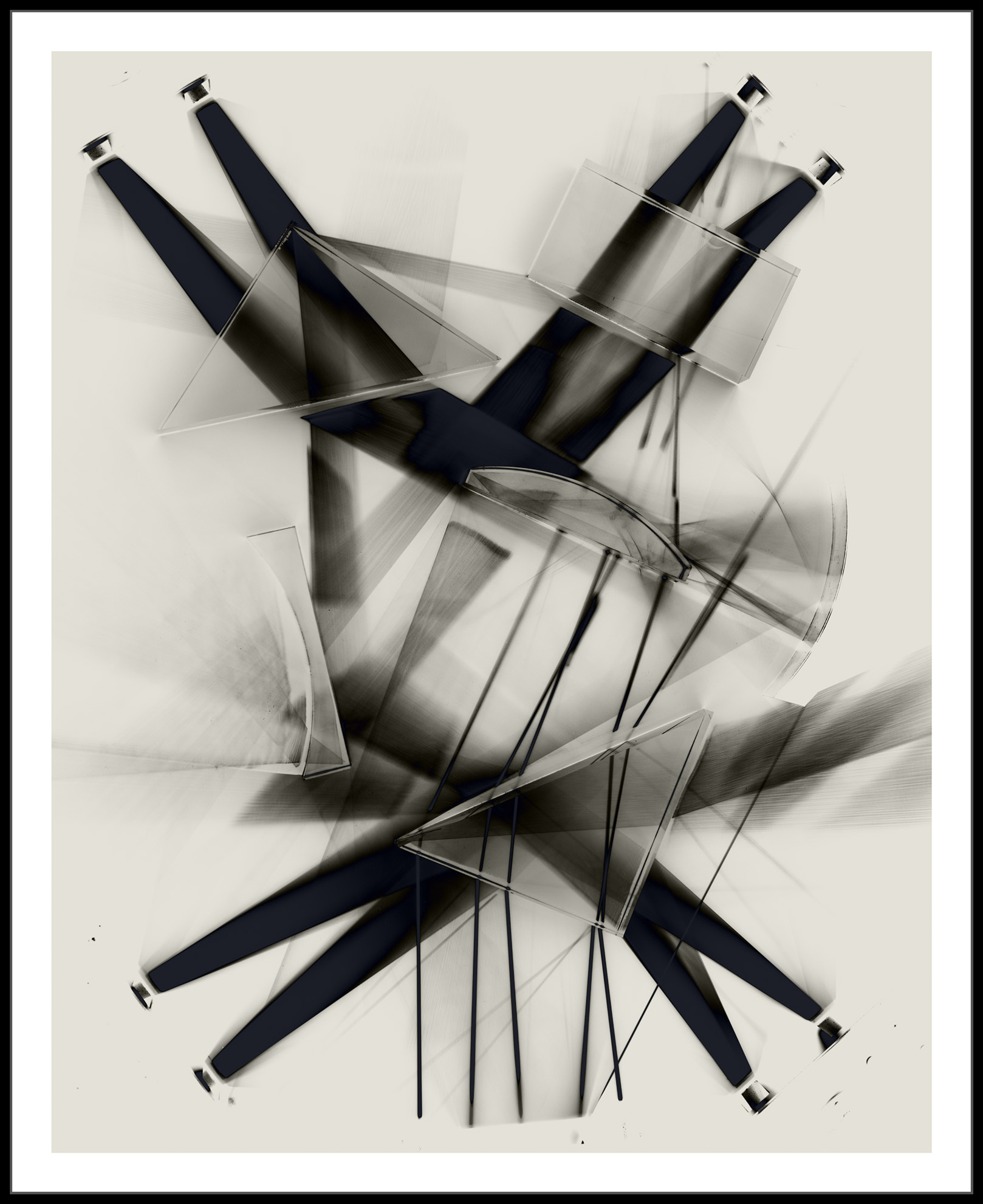
© Courtesy of Thomas Ruff & Mai 36 Galerie
For many years, Thomas Ruff has been exploring the origins and history of photography in his series. In doing so, he has always questioned the significance of the actual starting points of photography and its essence. In contrast to painting, physical phenomena of optics – such as light, refraction or radiation – and their fixation on a medium always play an important role in photography. The aim of the expériences lumineuses series was to examine this more scientific aspect, consisting of light, light rays and glass, more closely and visualise it with the help of ‘simple’ photography.
As he wanted to use ‘only light and glass’, he initially used a lamp and a glass prism to photograph rays of light and reflections that appeared on a rough concrete floor or on various white papers. However, as he was not convinced by the results, he decided to photograph the play of light on a shiny surface in order to make the rays more visible.
For this reason, he created an experimental set-up in his studio with the help of a multi-beam lamp and various glass bodies, which is used in physics lessons on the subject of geometric optics. In these demonstration experiments, light is projected through glass bodies arranged on a whiteboard. Depending on the nature of the light source and the glass bodies, light reflection, refraction and parallel, divergent or convergent light beams can be visualised.
Initially, he only had one lamp, which cast narrow or wide beams of light onto the surface depending on how it was used, but more lamps were subsequently added in order to multiply the lines of light refraction and make them more complex. The different light – from narrow rays to wide light beams – was channelled through various glass bodies such as cuboids, triangles, semicircles, concave and convex lens shapes as well as through different mirrors. The resulting light traces and reflections were unpredictable, but could be determined by arranging the lights and glass bodies. For Ruff, this was ‘playing with the rays of light and the arrangement of the glass objects from which the light is refracted’ before he pressed the shutter release.
Ruff inverted the images of the optical phenomena so that the path of the light beam through the glass body into the room could no longer be perceived as light, but as a line or stripe. The progression of light, refractions, reflections and the glass bodies were thus transformed into almost abstract drawings that have left the realm of the natural sciences. To emphasise the painterly-graphic quality of the images, Ruff had them printed on primed canvas and presented them as large-format drawings in the exhibition space.
Ruff once again makes it clear that he is convinced of the importance of scientific photography in the sense of Berenice Abbott: ‘Surely, scientific truth and natural phenomena are as good subjects for art as are man and his emotions, in their infinite variety. ’1
1 Quoted from: Ron Kurtz, Introduction: A Personal Note, p. 7, in: Berenice Abbott, Documenting Science, ed. by Ron Kurtz, Göttingen 2012
8001 Zürich
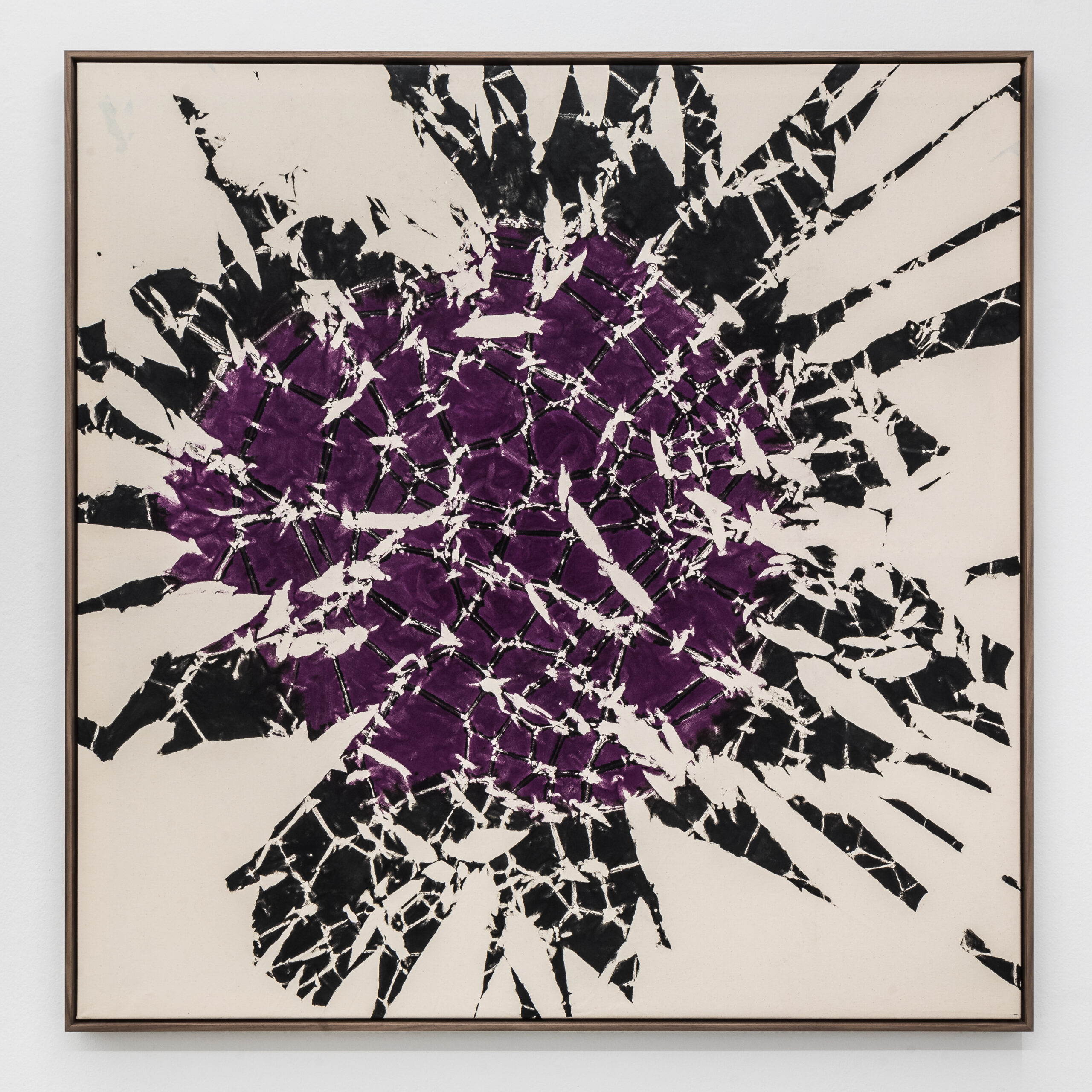
© Courtesy of Maia Ruth Lee & Mai 36 Galerie
Maia Ruth Lee (b. 1983, Busan, South Korea) is a visual artist whose practice spans photography, video, painting, and sculpture. Lee’s work explores language as a mechanism that can shape and give account to experiences, memories, and emotions. Her work also investigates lives shaped by precarity and a state of un-rootedness—maps, atlases, and banners become a device that calls to mind their life of movement, and often, loss. Using translation as an apparatus, Lee transmutes her works between mediums, connecting themes of borders, community, and language, with embodiments of carriers and self-preservation through process and materials.
Maia Ruth Lee has held solo exhibitions at Institute of Fine Arts, New York University (NY), The Museum of Contemporary Art Denver (CO), Francois Ghebaly Gallery (LA), and Jack Hanley Gallery (NY). Lee has participated in numerous group exhibitions including Prospect 6., New Orleans, the Aspen Art Museum (CO), 2019 Whitney Biennial, Whitney Museum of American Art, Helena Anrather Gallery, CANADA gallery, Studio Museum 127, Salon 94, Overduin & Co. Gallery, and Roberts & Tilton Gallery. Lee attended Hongik University in Seoul, and the Emily Carr Institute of Art and Design in Vancouver, Canada. Lee was the recipient of the Gold Art Prize in 2021 and the Rema Hort Mann grant in 2017. Her work is held in the public collections at the Whitney Museum of American Art
8001 Zürich
in collaboration w/ CAPSULE