Venues
ZHdK Research Tours
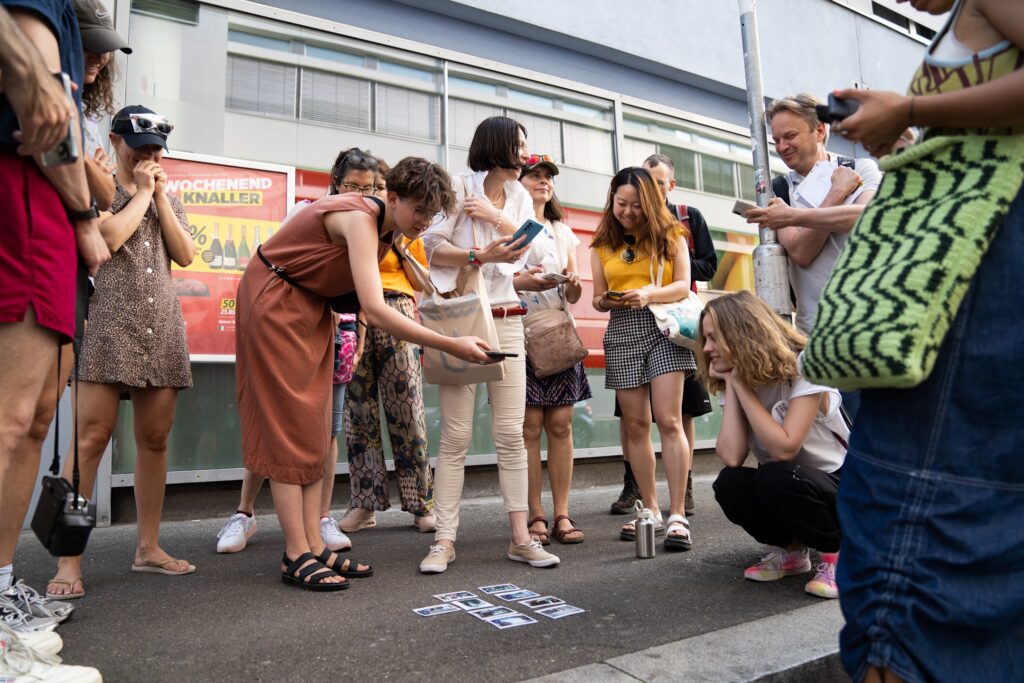
For Zurich Art Weekend 2026, an innovative research-driven tour format has been developed in collaboration with the MA Cultural Critique, Curatorial Studies (head: Prof. Dr. Anselm Franke) from Zurich University of the Arts (ZHdK) and with the support of Hannah Eßler. These tours will lead audiences to unique and behind-the-scenes locations across Zurich, guided by emerging curators Anja Roosens, Sonia Mesarova, Parita Upadhyaya, Juliette Cornaz, and Maria Sorensen.
This initiative builds on a long-standing collaboration between Zurich Art Weekend and ZHdK’s MA Cultural Critique, Curatorial Studies (former MA Art Education, Curatorial Studies) which began in 2018 and continues to foster art mediation practices and public education through guided tours.
Culminating the walk at the ETH Bildarchiv (Image Archive), we extend this inquiry to consider divisions not only between species, but also amongst humans, examining how the West has constructed perceptions of the “other.” Through images and prints, we attempt to form an understanding of how the scientific marker of progress reduces both plants and humans to objects of study, labour, and commodity. We also discuss its replication in art through the question/absence of representation.
Parita Upadhyaya is an architect, researcher, and curator whose work engages with archival research and colonial historiography. Working at the intersection of architecture and curatorial practice, her experience spans architectural exhibitions, interpretive planning, and teaching. Her research focuses on processes of meaning-making in the production of culture, inquiring how histories are constructed, mediated, and represented.
Anja Roosens (*2001) is a mediator and emerging curator, with an interest in photography and early modern history, currently pursuing a master’s degree in Curatorial Studies at Zurich University of the Arts. Sourcing from her background in Art History at the University of Bern and her time at the Precollege in Art and Design at HSLU DFK, she explores questions of archiving, museum history, and critical mediation, with particular attention to the mundane and its potential to evoke connections to stories yet to be told.
Sonia Mesarova is a curator and illustrator based in Zurich, currently enrolled in the
MA Cultural Critique, Curatorial Studies programme at ZHdK. In her curatorial
practice she works across disciplines, having been a member of Tate Collective
Producers at Tate St Ives and engages in collaborative and community projects,
organising music events in Somerset, UK. Since completing her undergraduate
studies in Illustration at Falmouth University, she has an interest in mediation and
focuses on printmaking in her artistic practice.
The historical position of Edition VFO within Zurich’s art scene, as well as the unique nature of its archives, will provide a central point for a reflection on contemporary print art. This journey will lead participants to question the challenges of today’s art production and the status of artworks.
Juliette Cornaz (*2000) works and lives between Zurich and Lausanne. She combines her practice as an interior architect with a Master in Cultural Critique, Curatorial Studies at ZHdK, Zurich University of Arts. Focusing on her interest in scenography, she works with various materials and media, combining practical and theoretical approaches. Guided by curiosity and attention to details, her work addresses questions related to art production and status of objects and places.
Our journey begins at the Collegium Helveticum, where through film and photography glaciers are presented as living archives, silently preserving traces of both human and planetary histories. We then move to the ETH Graphische Sammlung—one of Switzerland’s most important art collections of prints and drawings—where we encounter the remarkable works of Caspar Wolf (1735–1783). Renowned for his dramatic Alpine scenes, Wolf ventured into glaciated landscapes that were, at the time, largely unexplored. Today, his paintings not only captivate viewers but also serve as valuable references for researchers studying historical glacier extents.
The exhibition as a whole offers something for everyone: admirers of Switzerland’s majestic landscapes and those drawn to the refined artistry of drawing around 1800 alike will find much to appreciate. At extract at ETH, the focus shifts to the present, addressing the pressing challenges faced by melting glaciers in an era of climate change.
The tour concludes at the Helmhaus, where, in harmony with our overarching theme, we visit The Most Beautiful Swiss Books exhibition—an annual celebration of excellence in book design and production.
Maria Sorensen is an art curator, writer and a cultural analyst. Her practice unfolds at the intersection of art, politics, history, and cultural observation. Her writing has been published by Kunstmuseum Bern, London-based Index on Censorship, Berlin-based On Curating and ZHdK Curatorial Studies publication 4.T39. In August-September she is curating an exhibition of Swiss printmaking artist Maya Giesser inspired by Bulgakov’s novel Master and Margarita.
Anja Roosens (*2001) is a mediator and emerging curator, with an interest in photography and early modern history, currently pursuing a master’s degree in Curatorial Studies at Zurich University of the Arts. Sourcing from her background in Art History at the University of Bern and her time at the Precollege in Art and Design at HSLU DFK, she explores questions of archiving, museum history, and critical mediation, with particular attention to the mundane and its potential to evoke connections to stories yet to be told.
Zurich has long been home to major church–art collaborations, from Wasserkirche featuring Augusto Giacometti to Fraumünster with its iconic windows by Marc Chagall and the contemporary works of Sigmar Polke at Grossmünster. Since 2020, Johanneskirche has continued this dialogue, recently presenting Portal by Sarah Burger on view during Zurich Art Weekend. Meanwhile, at the current Venice Biennale, artists censored in their home countries are increasingly exhibiting in church spaces—highlighting a renewed connection between art and the church. In a second part in conversation with Tania Oldenhage we look at some of the biblical narratives and ask a question - what if the stories we inherited aren’t the only ones? Who was Mary Magdalene, really—sinner, protector or one of Christianity’s most powerful women? Together, we trace her shifting image across art history and popular culture.
Maria Sorensen is an art curator, writer and a cultural analyst. Her practice unfolds at the intersection of art, politics, history, and cultural observation. Her writing has been published by Kunstmuseum Bern, London-based Index on Censorship, Berlin-based On Curating and ZHdK Curatorial Studies publication 4.T39. In August-September she is curating an exhibition of Swiss printmaking artist Maya Giesser inspired by Bulgakov’s novel Master and Margarita.
Sonia Mesarova is a curator and illustrator based in Zurich, currently enrolled in the
MA Cultural Critique, Curatorial Studies programme at ZHdK. In her curatorial
practice she works across disciplines, having been a member of Tate Collective
Producers at Tate St Ives and engages in collaborative and community projects,
organising music events in Somerset, UK. Since completing her undergraduate
studies in Illustration at Falmouth University, she has an interest in mediation and
focuses on printmaking in her artistic practice.
The historical position of Edition VFO within Zurich’s art scene, as well as the unique nature of its archives, will provide a central point for a reflection on contemporary print art. This journey will lead participants to question the challenges of today’s art production and the status of artworks.
Juliette Cornaz (*2000) works and lives between Zurich and Lausanne. She combines her practice as an interior architect with a Master in Cultural Critique, Curatorial Studies at ZHdK, Zurich University of Arts. Focusing on her interest in scenography, she works with various materials and media, combining practical and theoretical approaches. Guided by curiosity and attention to details, her work addresses questions related to art production and status of objects and places.
We continue our walk through the Old Town of Zurich, a major trade and economic hub since the medieval times while contemplating the role of trade in the story of othering, especially that of colonialism. Culminating at the Old Botanical Gardens, we explore the history of division between the human and non-human beings, especially plants. We discuss the provocation by We are AIA’s exhibition ‘Botanical Memories’ to question the triumph of modern scientific knowledge over other forms. Through the artworks, we reflect on historical ruptures and trace the persistence of marginalised forms of knowledge.
Parita Upadhyaya is an architect, researcher, and curator whose work engages with archival research and colonial historiography. Working at the intersection of architecture and curatorial practice, her experience spans architectural exhibitions, interpretive planning, and teaching. Her research focuses on processes of meaning-making in the production of culture, inquiring how histories are constructed, mediated, and represented.